


The surname map of America: The most common last name in every state and the immigration story behind them
Every last name reflects generations of history and carries a unique story passed down through time.
The Smiths in your neighborhood may share a common last name, but they may be related to a prolific Anglo-Saxon metalworker. The Garcías, two houses over from you, may have descended from Spanish people who were naming cities before the United States ever existed. Your colleague, surnamed Nguyen, could trace their roots to the legacy of a royal dynasty and a refugee exodus that reshaped American demographics. Each and every person’s name carries weight.
The U.S. Census Bureau's 2020 names data, the most comprehensive tally of last names in a decade, yields interesting insights. While at the national level, the most common surnames have barely changed over time, there has been a shift in the U.S.'s fastest-growing names.
Smith, Johnson, Williams, Brown, and Jones have held the top five slots since at least 2000 and appeared among the top 15 most common last names as far back as the late 1700s. What has shifted, though, is just below the surface. The fastest-growing surnames in the U.S. are now predominantly Asian, and Hispanic names aren't far behind, surging into the top 15 in the new data set. ThatsThem leveraged Census data and Ancestry.com research to create a state-by-state map of the most common last names in the United States, revealing the nuanced story behind popular American monikers.
The data behind the map
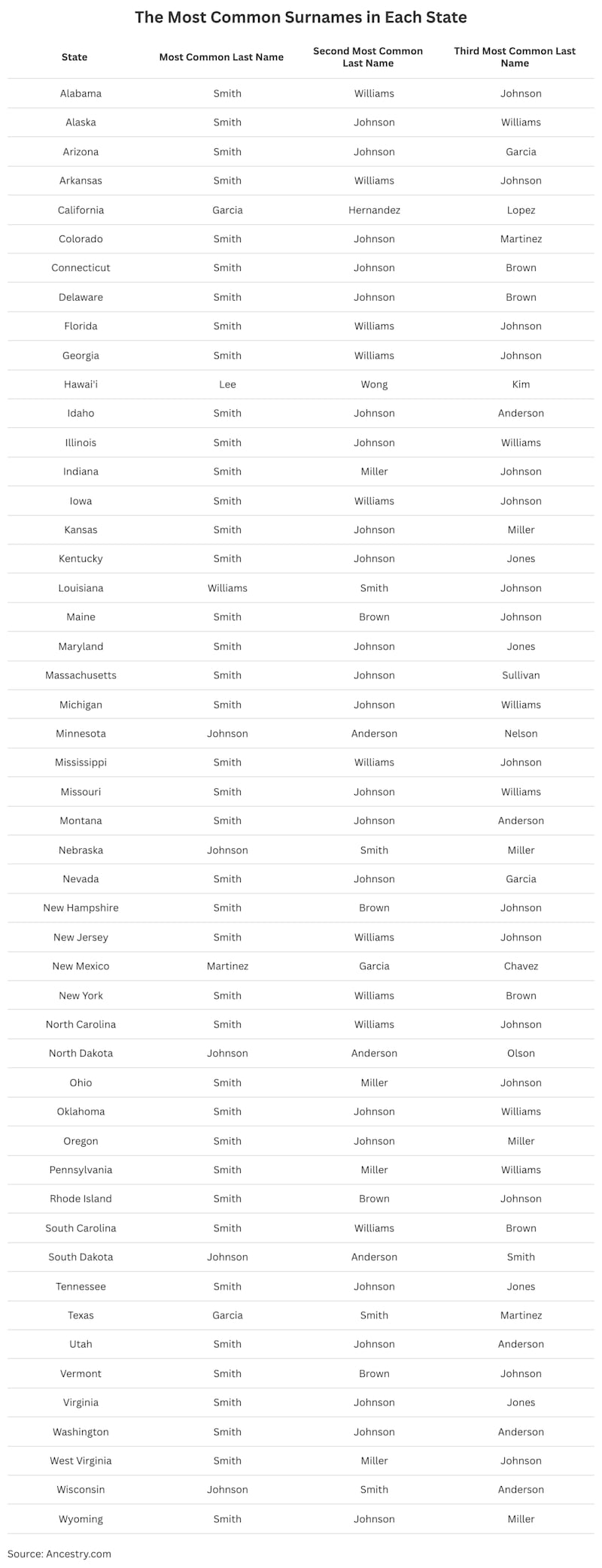
According to U.S. Census data, the 10 most common surnames in the United States are Smith, Johnson, Williams, Brown, Jones, García, Miller, Rodriguez, Davis, and Martinez. Regional-level data tells a different story, though. Ancestry.com data shows unique trends across the country:

ThatsThem
ThatsThem
At the state level, the map breaks down into several broad clusters. There’s Smith, which dominates the Eastern half of the country, broken up only by a cluster of Williams and García in the Central South. Johnson and Martinez create a neat dividing line through the middle of the country, before Smith returns to take over much of the West Coast. The only exception to that is a grouping of García in California and Lee in Hawai‘i.
On a broader national basis, Johnson also stretches across much of the South, Midwest, and East alongside Smith. Andersons also pop up throughout the northern Plains and Upper Midwest. In Hawai‘i, Asian surnames like Wong and Kim are also on the rise. Every cluster across the country hints at an imprint of who came, when, and where they ultimately settled.
The Smith Belt: Anglo-European settlement across the East and Midwest
Smith is the most common surname in the United States and has been for some time. Its dominance isn't a fluke, either. Per The Family Genealogy, which covers histories of popular names, Smith is derived from the Old English word smið, meaning a worker in metal. It eventually became Smith and was one of the most universal occupational names since every town needed a blacksmith.
The name arrived in colonial America from the start, including famed colonists like John Smith of Virginia. As the Anglo-British settlement continued along the Eastern seaboard and into the Midwest, the name persisted.
Something that makes Smith unusual is its demographic breadth. Unlike many other European-origin surnames, Smith is common among both white and Black Americans.
For some Black families, the name carries a painful legacy, tracing back to enslavers. For others, however, it was adopted freely after emancipation, chosen for a trade or personal significance. It is this dual heritage that helps explain Smith's enduring dominance as America’s most common surname.
The Nordic North: Johnson, Anderson, Olson, and the Scandinavian Midwest
In Minnesota, Wisconsin, the Dakotas, and parts of Nebraska, the most common surnames are shifting from English occupational names to more Scandinavian ones. Johnson leads in several of those states, and Anderson or Olson often aren’t far behind.
This prominence is due to a mass migration between roughly 1860 and 1900, according to Genealogy Explained. Sweden and Norway exported an enormous part of their rural population to the American Upper Midwest during this time. Immigrants were drawn by the promise of free farmland under the Homestead Act.
Word spread quickly through tight-knit village networks back home. In Scandinavia, surnames were technically supposed to change every generation, but due to American record-keeping, legal requirements, and pure confusion, the names of those who originally migrated stuck.
The Southwest: García, Martinez, and the Spanish Colonial Legacy
In New Mexico, California, and Texas, the surname map doesn’t reflect only recent immigration but also history.
García and Martinez are among the most common surnames in Spain and Mexico alike. They arrived in North America as part of the Spanish colonial project of the 16th and 17th centuries. When Texas became part of the United States in 1845, and the Mexican American War ceded much of the Southwest shortly after in 1848, those surnames came with it.
Since 2000, according to Census data, six Hispanic surnames have entered the top 15 despite none appearing there in 1990. That shift is representative of the fact that the Hispanic population is among the fastest-growing in communities around the country. What were once regionally concentrated surnames are now starting to become nationally prominent.
The New Arrivals: Nguyen, Lee, Kim, and the Asian Surname Surge
Lastly, no surname pattern in the 2020 Census data was more striking than the rise of Asian last names. In the 10 years since the 2010 Census, all but one of the fastest-growing surnames in the top 1,000 were predominantly Asian.
Zhang, Liu, and Wang led the list. AP News reported that the rise in Asian surnames reflects broader shifts in U.S. immigration patterns.
Nowhere is this more visible than in Hawai‘i, where the three most common surnames are Asian in origin. These last names don’t appear in the top three of any other state. This reflects the state’s plantation-era history, which brought Chinese and Korean laborers to the islands.
On the mainland, Nguyen has become one of the most recognized markers of Vietnamese origin, especially in California and Texas. The name is extremely common in Vietnam, rooted in the centuries-long practice of adopting it as a gesture of loyalty to the royal dynasty. It arrived in the U.S. along with mass refugee migrations in the late 1900s.
What hasn't changed, and what has
The surname Smith is likely to hold its national dominance for decades more, but the names joining it are a different story. The rise in Hispanic and Asian surnames speaks volumes about shifting immigration patterns, with several last names set to be leading contenders in the near future.
Some names mark the oldest colonial footprints. Others trace refugee crises. Others follow family bonds that go back generations. When all taken together, the American surname map doesn’t show just who’s here, but also how and when everyone arrived.
This story was produced by ThatsThem and reviewed and distributed by Stacker.